
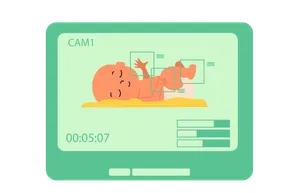
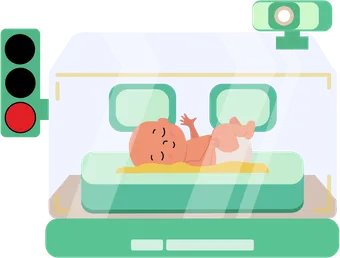
Computer screen showing sleep insight Camera setup concept above a neonatal incubator

Science

Sleep science, translated into neonatal care

I See U started with a scientific question: what if we could actually detect and visualize sleep stages, helping the care team optimize sleep?

This page brings together the special observable sleep behaviour in preterm infants and the sleep science context behind our work.

First: what we can observe

Preterm sleep behaviour

Preterm sleep can look restless, quiet, fragile, or awake. The visible behaviour matters, but it is not always easy to read.

This section explains what can be seen during sleep, how sleep states develop, and why the move from womb to NICU changes the sleep environment.

Visible Behaviour

Sleep is visible, but not always easy to interpret

In babies, sleep is not silent stillness. It can include facial expressions, small twitches, irregular breathing, eye movements, stretches, startles, and changes in muscle tone. Especially in preterm infants, these behaviours can be subtle, brief, and difficult to distinguish from wakefulness.

This matters because caregivers and parents often rely on visible behaviour to understand whether a baby is asleep, awake, comfortable, or unsettled. But a preterm baby may look active while actually being asleep, in a state called active sleep.

At I See U, we distinguish three states that are well known in preterm sleep science: quiet sleep, active sleep, and wake.

The behavioural tracking method to keep these sleep stages apart was co-created by the founder of I See U during her academic career at the Wilhelmina Children's Hospital (article).

On the ward, the challenge is not that people are careless. The challenge is that preterm sleep behaviour is complex, developmental, and often hard to classify by observation alone.

State Eyes Movement Crying
Quiet sleep Closed eyes Little movement No crying
Active sleep Open eyes can occur More movement Crying or vocal signals can occur
Wake Open eyes More movement Crying can occur
Notice the similarities between active sleep and wake

Before Birth

In the womb, sleep develops in a protected sensory environment

Before birth, the fetus develops in a warm, dark, rhythmically moving environment. Sound is filtered, light is limited, and many external disturbances are softened by the womb. Sleep and rest are part of this protected developmental setting.

In the final trimester, babies sleep for most of the day. For a baby born too early, part of this period suddenly takes place outside the womb, inside the NICU. The brain is still expecting developmental conditions that are biologically closer to the womb, while care must now take place in a medical environment.

That transition is unavoidable for many preterm infants. But it helps explain why protecting sleep, reducing unnecessary disturbance, and timing care thoughtfully are so important.

In the NICU

In hospital, sleep has to coexist with necessary care

For preterm infants, sleep develops in an environment very different from the womb. The NICU is lifesaving, but it is also an environment where noise, light, painful procedures, and necessary medical interventions can regularly disrupt sleep.

Many NICU protocols already recognize this. They include recommendations to cluster care, reduce light and noise, support positioning, protect rest, and adapt handling to the baby's state whenever possible.

The difficulty is that this requires knowing the baby's sleep state in real time. If sleep state is hard to judge, sleep-supportive care becomes difficult to apply consistently, even when the intention is there.

Why It Matters

Recognizing sleep behaviour can support gentler timing

Understanding sleep behaviour does not mean avoiding care. It means helping care teams decide when an intervention is urgent, when it can be timed more gently, and when a baby may benefit from protected rest.

For parents, better insight into sleep behaviour can also reduce uncertainty. A baby who looks active may still be sleeping. Clearer information can support more confident, sensitive interaction.

The scientific and clinical challenge is to move from occasional, subjective interpretation to continuous, objective insight, without adding contact, wires, or disturbance. For an overview of the hospital and patient benefits, click here.

Then: why it matters biologically

The context of sleep science

This section shares scientific background on infant sleep, preterm birth, and early brain development. It is written to give context, not medical advice.

I See U Baby Care is developing a non-contact tool for neonatal sleep observation. The scientific literature below helps explain why sleep quality in early life deserves careful attention.

How to Read This

Each topic below can be opened separately. The wording is deliberately careful: associations are not the same as proof of causality. More research on sleep in babies, especially preterm infants, using proper measuring tools and larger cohorts is highly welcome. Clinical decisions should always be made by qualified healthcare professionals.

Scientific Themes

What sleep supports in early life

Open each theme to read the scientific explanation and the sources behind it.

01 Foundation Sleep is not rest, it is work A sleeping baby may look peaceful, but the brain is anything but passive.

A sleeping baby looks peaceful. But what is happening inside that small brain is anything but passive. The brain is growing, neural connections are forming, memories are being laid down, and growth hormone is being released. Sleep is not a pause in life, sleep is a large part of living itself.

For newborns, this is especially true. In the first year of life, a baby spends more than half of her time asleep. For preterms in their first weeks born, this can even be up to 90% of the day. That is not a biological coincidence. It is a signal of how fundamental sleep is during this period. Because at that time, when the brain is growing at a pace it will never match again, many critical developmental processes happen while sleeping.

02 Active Sleep The role of active sleep Active sleep supports early neural plasticity, sensory development, and the maturation of brain networks.

The sleeping brain is not off. It is busy building.

During active sleep, the early precursor to what later becomes REM sleep, connections between neurons are formed and strengthened. This process is critical for the maturation of the visual system, the motor system, and the broader neural plasticity of the brain.

A review published in Pediatric Research in 2024 describes sleep as one of the central driving forces behind brain development, both before and after birth.

A separate review by Lokhandwala and Spencer, published in Developmental Cognitive Neuroscience in 2022, analysed studies in both humans and animals. Disruptions to active or REM sleep in early life are associated in animal models with reduced neural plasticity, particularly in the maturation of the visual system and motor circuits.

The fact that babies sleep so much is not a sign of weakness or fatigue. It is the biological programme of a brain running at full capacity.

03 Learning Sleep supports early learning and memory Infant sleep supports memory consolidation from the first year of life.

Babies learn during sleep. That may sound surprising, but it is scientifically established.

Researchers at Ruhr University Bochum and the University of Sheffield showed 6- and 12-month-old babies new actions, after which half the group slept and the other half stayed awake.

The result was clear: babies who slept for at least 30 minutes within four hours of learning retained the new behaviours significantly better, 4 to 24 hours later, than babies who remained awake. Babies who did not sleep after learning showed almost no retention.

The researchers concluded that babies depend on frequent naps for the formation of long-term memories. Memory consolidation, the process by which new information is stored, is active in the first year of life and is inseparably linked to sleep.

Every nap is therefore more than recovery. It is the moment when the brain processes, organises, and stores the day.

04 Growth and Immunity Sleep is linked to growth, repair, and immunity Deep sleep and immune activity are both part of the body's early developmental work.

Sleep is closely connected to several body systems that are still developing in early life. One example is growth hormone, which is essential for physical growth, muscle development, and tissue repair. In children, its release is strongly linked to deep sleep, especially the first deep sleep episode after falling asleep.

This connection is also visible in infant growth patterns. A study published in SLEEP in 2011 found that periods of longer sleep and increased naps were followed by greater increases in body length in babies.

Sleep and immune development are connected as well. During sleep, the body produces cytokines, proteins that help fight infections and inflammation. Sleep disruption can affect this system, likewise illness can affect how and how much a baby sleeps.

A longitudinal cohort study in children aged 2 to 5 found that children who consistently slept less than their peers had higher blood levels of IL-6 and TNF-alpha at age five. These markers are linked to elevated immune activity and low-grade inflammation. Together, these findings do not prove simple causality, but they do show why sleep is relevant far beyond rest alone.

05 Prematurity Preterm sleep is tied to brain development Studies link sleep quality, reduced noise, and active sleep in the NICU with neurodevelopmental outcomes and white matter growth.

A review published in Nursing for Women's Health states that growing evidence indicates sleep quality is essential for the development of the central nervous system and is associated with long-term neurodevelopmental outcomes.

Research shows this has measurable consequences. A study of 34 preterm infants found an association between noise reduction via silicone earplugs and better scores on the mental development index at 18 to 22 months, with sleep identified as the mediating factor.

Researchers at UMC Utrecht published a study in the Journal of Neuroscience in 2024 in which machine learning was used to measure active sleep in preterm infants based on routinely recorded heart rate and respiratory signals. The finding: a higher percentage of active sleep during the preterm period, 29 to 32 weeks postmenstrual age, was significantly associated with greater white matter volume at term-equivalent age.

White matter is the network of connections in the brain that enables communication between regions. This finding does not prove causality, but it does show that active sleep is not just background behaviour: it may carry important information about early brain development in preterm infants.

06 Neural Refinement Sleep wires the brain, then fine-tunes it Active sleep and deep sleep each play a distinct role in how the brain wires and rewires itself.

During active sleep, the brain is not only consolidating what it learned. It is also physically forming new neural connections. Synaptogenesis, the creation of new synapses, is closely tied to active sleep in early development. This is part of why active sleep dominates so completely in the newborn and preterm period: the brain is quite literally under construction.

As the brain matures, sleep takes on an additional role. The Synaptic Homeostasis Hypothesis, developed by Tononi and Cirelli at the University of Wisconsin, proposes that deep sleep also scales back synapses that are no longer needed. Connections that are used are preserved; weaker ones are pruned. This refining process improves efficiency and signal quality across childhood and adolescence.

In autism spectrum disorder, this refining process appears less effective in some studies. Research on postmortem brain tissue shows that autistic brains retain higher axon density in areas associated with communication and social processing, consistent with reduced pruning over time. Immunological research points to impaired microglial function as a possible mechanism: these are the cells responsible for identifying and removing surplus synapses.

Whether disrupted sleep in early life contributes to this pattern in humans has not been established. Animal studies show that sleep deprivation impairs the microglial pruning mechanism, but direct evidence in infants is lacking. What is established is that the amount of active sleep during the preterm period is associated with white matter volume at term-equivalent age, one measurable marker of how the developing brain is building its connection infrastructure.

07 Neurodevelopmental Risk The association between preterm birth, ADHD, and autism Preterm birth is associated with higher rates of neurodevelopmental difficulties, but the presentation, and likely the underlying cause, differs from what is seen in term-born children.

Preterm birth is a well-established risk factor for neurodevelopmental outcomes. A meta-analysis based on 52 studies found autism features in 20% of preterm populations using screening tools, compared to 1-2% in the general population. A 2025 review confirms elevated ADHD rates across all preterm subgroups.

But preterm ADHD is not simply more ADHD. Research describes a distinct preterm behavioral phenotype: predominantly inattentive rather than hyperactive, less associated with conduct difficulties, and more closely linked to structural brain differences, particularly white matter abnormalities in frontal-limbic tracts, than to the dopamine dysregulation that characterises ADHD in the general population. These are different problems at a structural level, and that distinction matters for how children may respond to interventions.

White matter alterations in preterm-born children are measurable into adolescence and adulthood, and are associated with poorer performance on sustained attention and processing speed tasks. The connection to sleep is the same one described in the prematurity section above: active sleep during the NICU period is associated with white matter volume at term-equivalent age. Structural brain development, sleep quality, and later neurodevelopmental profiles are connected, though the direction and magnitude of those relationships is still being mapped.

A prospective longitudinal study by Begum-Ali and colleagues, published in the Journal of Child Psychology and Psychiatry in 2023, followed 164 infants from 5 to 14 months. Lower night sleep scores in infancy were associated with a later autism diagnosis at age three, reduced cognitive abilities, and changes in social attention. Whether poor sleep is an early signal of a neurodevelopmental difference, a contributing factor, or both remains an active area of research.

08 Scientific Honesty What sleep science can and cannot say yet The evidence is meaningful, but it does not justify overconfident claims.

Scientific honesty belongs in this conversation.

We do not yet know exactly how much sleep a preterm infant needs at each gestational age. We do not know which type of sleep disruption has the greatest impact on which aspect of development. And we cannot say with certainty whether better sleep in the NICU leads to measurably better cognitive outcomes in the long term, let alone that it prevents autism or ADHD.

The causality question is complex: sleep difficulties can be both an early signal of a neurodevelopmental difference and a contributing factor to it. In all likelihood, it is both, depending on the child and the context.

That does not mean sleep is unimportant. It means we are honest about what we know and what is still being studied. The mechanisms are plausible, the associations are demonstrable, but making definitive claims would take the science further than it has gone.

Taken together, sleep research points in one direction: sleep is biologically fundamental, early sleep patterns are associated with developmentally relevant outcomes, and making sleep more visible and actionable should support parents and caregivers in protecting an important part of early development.

Important Note

All information on this page is intended for educational and informational purposes only. This page does not provide medical advice, diagnosis, treatment guidance, or clinical instructions. Clinical decisions should always be made by qualified healthcare professionals.