
About I See U
Advancing neonatal care together
Sleep is essential for the growth and development of prematurely born babies, yet it is one of the hardest aspects of care to measure objectively. I See U Baby Care is developing non-contact sleep monitoring technology that helps bring sleep into focus, supporting clinicians and researchers in advancing neonatal care together.
Team
A multidisciplinary team for a sensitive clinical problem
Developing technology for neonatal care asks for more than a technical solution. It takes scientific curiosity, careful product judgment, responsible business building, and a deep respect for families and care teams.
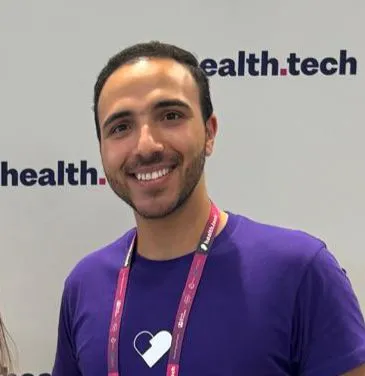
Mousa
CTO
Mousa works on the technical foundation needed to make non-contact monitoring reliable, responsible, and ready for clinical environments.

Mush
Financial strategist
Mush helps build the financial structure behind the startup, so the team can grow with focus and make careful long-term decisions.

Ayman
Machine Learning engineer
Ayman works on the machine learning challenges behind sleep state insight, translating subtle visual signals into meaningful information.

Omar
Hardware engineer
Omar works on the complete prototype setup, connecting the hardware, software, and clinical workflow so the system can function reliably and optimally for hospitals.
Join us
Want to contribute to this work?
We would love to hear from you. Send us an email, click here.
Mission & Vision
Two missions, one vision for neonatal care
We do not place everything under one mission statement. I See U is built around two connected missions: protecting the baby's development and making neonatal care easier to coordinate.
Support optimal development by protecting the rest each baby needs
Prematurely born babies need deep, restorative sleep to grow, recover, and develop. Our first mission is to help care teams understand sleep objectively, without adding unnecessary contact, wires, or disturbance.
Improve efficiency by making neonatal care easier to coordinate
Our second mission is to reduce unnecessary back-and-forth for ward staff and make it easier to divide care tasks with parents. Better sleep insight can help teams decide when to act, when to wait, and how to protect calm around the incubator.
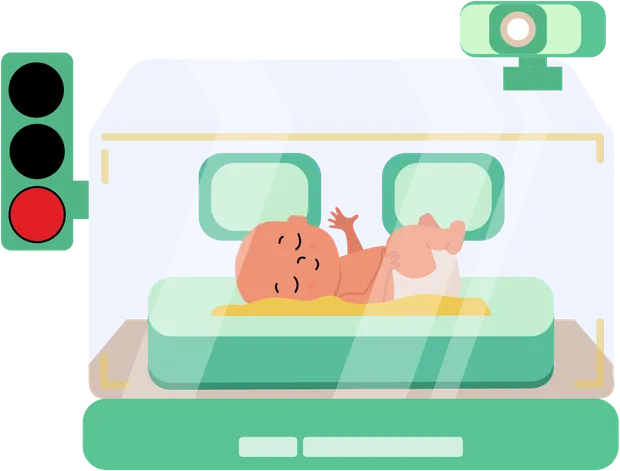
A neonatal ward where objective sleep insight from I See U supports better timing, care, and comfort
Through the use of I See U, we envision a future where neonatal care teams can use objective sleep insights to support individualized care routines, parents can better understand their baby's rest, and hospitals can integrate monitoring responsibly into existing workflows.
What Guides Us
Gentle technology, strict standards
We take our responsibility in neonatal care seriously. These are the principles we place first, so care teams, parents, and partners can understand what it means to trust I See U.
Care teams first
Technology should support clinical judgment and fit into ward routines without adding avoidable complexity.
Evidence before claims
Clinical value must be built through careful co-creation, validation, and transparent communication.
Privacy by design
Observation technology for neonatal care must be developed with safety, dignity, and data protection from the start.
Timeline
A living record of the milestones that shape I See U
A compact map of the programs, awards, partnerships, funding moments, and team decisions that moved I See U from research roots toward clinical development. Want to know where I See U stands today? Go to Where are we now.

Transformed online presence
I See U launched a renewed website and new logo, creating a clearer explanation of what the company stands for, who is behind it, and how its non-contact neonatal sleep monitoring vision is developing. New logo, same us.

One-week visit with an American neonatologist
Through the YTILI reciprocal exchange award, the founder invited one of the outstanding doctors she met in the United States to the Netherlands for a one-week visit focused on further developing the I See U concept, exchanging clinical perspectives, and learning from the Dutch healthcare context.

Setting up collaboration with a leading U.S. children's hospital
I See U began shaping a collaboration with a leading U.S. children's hospital to support the next step in algorithm development: learning from clinical data, testing in a specialist neonatal context, and refining the technology with direct clinical insight. The effort is driven by a neonatologist and sleep researcher who sees strong potential in bringing objective sleep insight into neonatal care.

Team grows to five members
After validating the concept and sharpening the business direction, I See U shifted its focus toward building the solution and expanded into a five-person team across technology, strategy, software, and machine learning.
Breda Startup Award pitch competition audience award
I See U won the audience award at the Breda Startup Award pitch competition, with strong support from the room showing how deeply its story and societal relevance resonated with the audience.

SANtiAgo Healthcare Innovation Fund - WISE Award
I See U received the WISE Award from the SANtiAgo Healthcare Innovation Fund, a women-focused medical innovation award supporting female medtech entrepreneurs with education and development funding. The award was presented during the TOPX Event on 13 November 2025.
Pitched and landed a collaboration with a Dutch hospital
I See U pitched and landed a collaboration with a highly innovative Dutch hospital. More information will follow soon.
Young Transatlantic Innovation Leaders Initiative
I See U was selected for the Young Transatlantic Innovation Leaders Initiative (YTILI) Fellowship Program, combining virtual leadership development with a five-week U.S. fellowship, including a three-week placement with an American host organization, direct engagement with the U.S. business sector, and access to an international alumni network.

Philips Innovation Award Rough Diamond League
I See U was selected for the Philips Innovation Award trajectory and advanced through the semi final to the Grand Final in Theatre Rotterdam. After pitching before a jury led by Philips CEO Roy Jacobs, I See U won the Rough Diamond League.

Receiving funding Startup Fund Utrecht
I See U received a EUR 68k loan from Startup Fund Utrecht, an initiative of Rabobank Utrecht, Utrecht University, Utrecht Holdings, and the Netherlands Enterprise Agency (RVO), executed by UtrechtInc to help ambitious startup entrepreneurs overcome their first funding needs and accelerate development.
I See U B.V. founded
I See U was formally established as a B.V.
Winner of the Health Impact Accelerator
I See U completed and won the 10-week Health Impact Accelerator, sharpening the value proposition, stakeholder strategy, competitive positioning, and financial model with sector coaches and experts before pitching the final business plan to an expert jury.
Top Female Founder Summer School
The founder was selected from many applicants for the EIT Health Top Female Founder Summer School, combining online training with one week onsite in Vienna. The program focused on healthcare innovation, value-based business models, leadership, stakeholder alignment, and pitching.
Winner of the NL Startup Competition tech category
I See U joined the national NL Startup Competition, gaining access to expert-led sessions, pitch opportunities, and a broader startup network. In the final pitch competition, I See U won the tech category.
Winner of the Sustainable Healthcare Challenge
I See U joined the Sustainable Healthcare Challenge training track for healthcare startups, connecting with companies across the care sector. The final pitch competition was won with the jury award, audience award, and several in-kind prizes from sponsor companies.

Eight-month Science Validation Program at UtrechtInc
I See U joined UtrechtInc's part-time Science Validation Program to validate the market, strengthen the business case, and learn from coaching, peer sessions, and masterclasses.
Founder starts I See U as an independent startup
After completing her master's degree, the founder started I See U independently from the research group. The research group continued its scientific research line on the importance of sleep and sleep measurement, while the startup focused on hospital implementation and the work needed to build a robust algorithm that fits clinical practice.
UMCU/WKZ research group wins UREKA Mega Challenge prize
The involved UMCU/WKZ research group won the UREKA Mega Challenge prize for the scientific work and project direction. The founder of I See U Baby Care was part of the research team and a core member of the competition team, including the business case.

Founder completes neuroscience master and NICU internship
The founder followed a master's degree in neuroscience and completed a one-year internship at the NICU department of the Wilhelmina Children's Hospital in Utrecht.
Where are we now
Where are
we now
I See U is moving from scientific context toward clinical implementation.
A lot is already known about sleep, and the field keeps growing. Most evidence is still strongest in children and older adults, while the database around babies and preterm infants is now rapidly expanding.
Collaborate with us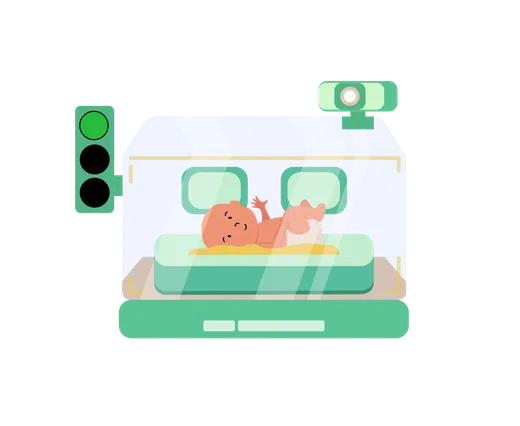
From bench to bedside
Science is the starting point, implementation is the work ahead. We are currently not only optimising our algorithm. Together with partners we are also building the right clinical, technical, and research structure around it, with enough validation to make the system useful in real hospital practice.
Origin
I See U started with science and a clinical problem
The first ideas behind I See U were shaped during academic work at UMC Utrecht, where the question was how neonatal sleep could be assessed in premature babies using non-invasive technology. That early scientific setting made one thing clear: sleep is fundamental for development, yet in neonatal care it is still difficult to understand sleep continuously and objectively around the incubator.
After the research team's concept gained recognition in an internal medical-center innovation competition (UREKA), the practical need became even clearer. The problem was not a lack of intention. Many neonatal protocols already include the wish to optimize sleep, cluster care, reduce disturbance, and adapt handling to the baby's state. The will to protect sleep is already present in many care environments.
I See U Baby Care was founded independently by Chanel Sam after her NICU internship, master's training in neuroscience, and additional business development training. The academic research line continues separately, while I See U focuses on translating scientific insights into practical, privacy-first technology that can be developed responsibly for clinical environments.
Validated Clinical Gap
Human observation alone is not enough
Sleep protection is already part of neonatal developmental care. International and hospital-level guidelines describe sleep as important for brain development and recommend adapting care to the infant's sleep-wake rhythm, reducing unnecessary disturbances, clustering care moments, and involving parents in sleep-supportive care. The European Standards of Care for Newborn Health even state that neonatal units should have an up-to-date guideline on sleep protection, including comfort, quiet environments, and light control.
The challenge is not that neonatal teams need to be convinced that sleep matters. They already know it does. In a Dutch study among 427 neonatal healthcare professionals from 34 hospitals, clinicians reported that they consider sleep especially important for infants in the NICU, and 91.8% said they adapt the timing of elective care procedures to sleep. At the same time, the study found limited knowledge of sleep physiology, noted that active sleep and wakefulness may often be wrongly assessed, and showed that sleep is still rarely discussed during rounds or handovers.
This is the gap I See U addresses. Care teams and parents want to protect sleep, but they do not currently have a practical, objective way to see sleep stages continuously and also from a distance. This was also reflected in our own interviews with healthcare providers: "It would be great if we could really see, also from a distance, whether the baby is actually awake."
I See U turns an existing clinical intention into actionable insight. By making sleep stages visible, we help hospitals support developmental care, plan interventions more appropriately, involve parents more meaningfully, and integrate sleep-aware care into everyday neonatal workflows.
Read the Dutch neonatal sleep practices studySafe Collaboration
We built a federated learning setup for hospital collaboration
To develop this responsibly, collaboration with hospitals must be safe by design. I See U has therefore set up a federated learning approach, allowing algorithm development across multiple hospital settings without requiring sensitive video data to leave the hospital environment.
This collaboration has two separate but connected tracks. For the algorithm, we want to work with hospital partners so the model can learn from diverse neonatal data while privacy, data ownership, and institutional control remain protected. Videos can remain securely on the hospital's own server.
For the hardware and clinical setup, we are also working with hospital partners to test positioning, workflow, usability, and integration around the incubator. The goal is not only to build a technically strong algorithm, but also a practical setup that hospitals, clinicians, parents, and researchers can trust.


Current Work
We are developing and testing with clinical partners
I See U is currently working toward collaboration with a leading children's hospital in the United States to optimize the algorithm in a specialist neonatal setting. The focus is on learning from clinical data, improving performance, and developing the system with direct input from neonatal expertise.
In the Netherlands, I See U is also working with a hospital partner to further develop and test the physical setup around the incubator. This includes practical questions such as positioning, workflow, usability, and how the system can fit into the clinical environment without adding burden.
I See U has built its own first algorithm. The next step is to optimize that algorithm and make the right hardware setup decisions, so the system can move from promising development toward a first real pilot in 2027.
Both directions matter. The algorithm must become scientifically and technically stronger, and the setup must work in real hospital practice.
Open Questions
There is still a lot we want to answer in consortium form
Many scientific questions could use more evidence. How does sleep influence physical growth and recovery? How does sleep support early brain development? What is the relationship between sleep and immune development? Do different sleep stages need different levels of protection? What is the best timing for care, feeding, and parental interaction? What happens when sleep becomes visible in daily practice?
These are not questions I See U wants to answer alone. We are interested in consortium-based collaboration with hospitals, researchers, clinicians, technical partners, and other stakeholders who want to study neonatal sleep in a careful and clinically meaningful way.
We would also like to test and optimize the effect of our system in more hospitals. This can be done safely: videos can remain on the hospital's own secure server, while the collaboration focuses on algorithm improvement, clinical validation, and responsible implementation.
What We Believe
Every sleep interruption we can prevent is one worth fighting for
At I See U, we already believe this fully. The science is still growing, but the direction is clear enough to act carefully: protect rest where possible, measure better, and build tools that help care teams make sleep-aware decisions.
Collaboration
Help answer the open questions with us
We welcome conversations with hospitals and research partners who want to study, test, and optimize objective sleep insight in neonatal care. The collaboration model is designed so that sensitive videos can remain safely within the hospital environment.
Collaborate with usDo you want to create a new milestone with us?
The I See U story is still being written. We welcome conversations with hospitals, researchers, investors, and care innovators.